BEN FERRAIUOLO
  • Home
  • Yellowstone
    • Yellowstone Blog
    • 2008-2009 Yellowstone Lake Dike Intrusion
    • Rapid-Fire Swarms 2014-2018
    • Steamboat Geyser Eruptions >
      • Steamboat Eruptions 2020
      • Steamboat Eruptions 2019
      • Steamboat Eruptions 2018
  • Hawaii
    • Hawaii Blog
    • Hawaii Spasmodic Tremor
    • 2018 Kilauea-LERZ Eruptions
  • How To...
    • ...Retrieve Seismic Data
    • ...read webicorders/helicorders and seismic plots
    • ...Understand Spectrograms
    • ...USE SWARM Software
    • ...use jamaseis program
    • ...use waves program
    • ...understand UTC
    • ...Read/Create GPS Deformation Charts
    • ...use s.w.a.r.m. program (OLD)
  • Seismic Events
    • Event Examples
    • Exotic Events
    • Whale Calls
    • Cascade Volcanoes' Low Frequency Events
  • Seismo-Blog
  • Other Seismic Blogs
    • Quake Swarms
    • United States
    • East Coast, USA
    • World
  • Monthly Volcano Updates
  • Uplift/Subsidence Update
  • Videos/Multimedia
    • Newberry Videos
    • (OLD) 2019 Monthly/Yearly Updates
  • Seismic Software
    • jAmaSeis
    • SWARM
    • WAVES
  • Seismic Network Help
  • Links
  • About Me
  • Contact
  • Test Your Knowledge!
  • Lucas Andrew Ferraiuolo (Pro Pics)
  • Garbage Trucks?!

Yellowstone Caldera, WY

Feb. 19-20, 2019 Minor Rapid-Fire Swarm at Northern Tip of Yellowstone Lake

2/19/2019

0 Comments

 
The video above quickly shows analysis of the small rapid fire swarm that just recently took place likely under the northern tip of Yellowstone Lake. The amplitudes were not great, barely exceeding 4,100 amplitude count for the largest event, but the swarm was followed by a great many low amplitude low frequency seismic events. These tiny "poppings" were not present prior to the swarm and occurred right when the swarm ended. As of an hour ago or so, right now is 5:50UTC February 20, 2019 (9:50pm PST Feb. 19, 2019), the low frequency weak "popping" has calmed and was only seen after the swarm. This is quite odd and shows the small LF events after the swarm are likely connected to the swarm itself.

Please CLICK HERE to visit the link of the video above. It does NOT contain as accurate of a description as the analysis in this post. Please click the title of this post or "read more" if you haven't already.
Picture
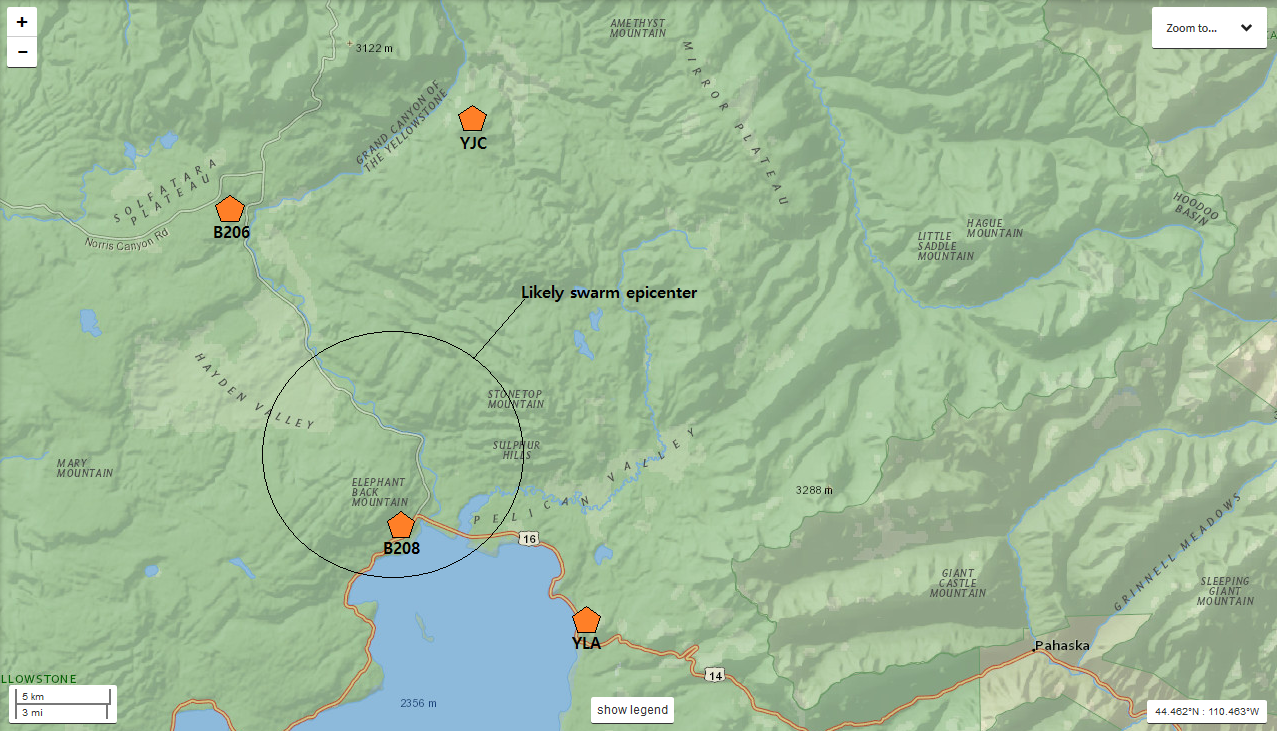
Early in the UTC day for February 20, 2019, a small but energetic swarm broke out under the northern tip of Yellowstone Lake. In the intro of this post is a video quickly detailing this swarm. However many more details are shown below that were not shown in the video. In the image directly above, I have detailed the likely swarm epicenter and the locations of the 4 closest seismic stations. B208 in the PB network felt these events the strongest, also seeing the events arrive first.

Below I will show some quick details of this swarm and then I will show the helicorders to the closest stations, some plots of this swarm, 3-plot images closely detailing most of the swarm (in slideshow format), and some more plots detailing the low amplitude low frequency events that were spotted just after the swarm ended (also in slideshow format). Remember to read all chart labels and any captions beneath any images!

February 20, 2019 rapid-fire micro-quake swarm under the northern tip of Yellowstone Lake:

Start of swarm: 00:09UTC
End of swarm: 00:25UTC

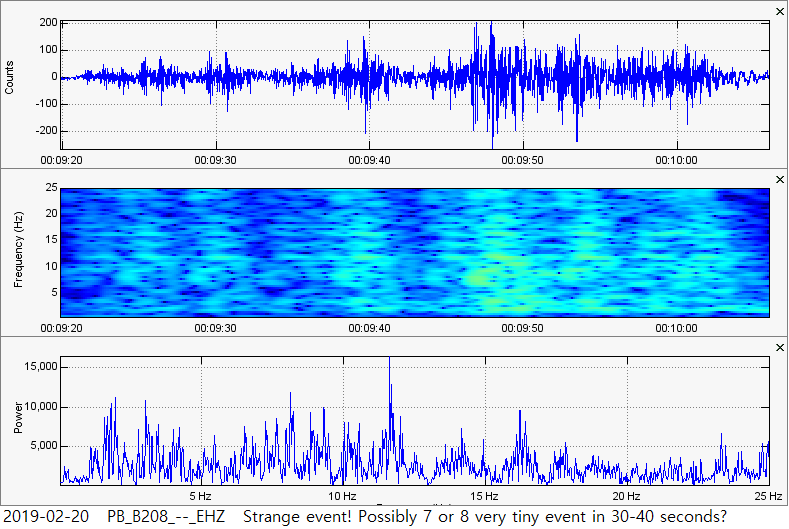
Note: Although this swarm has not been reported, it is likely it occurred very near to B208 under the northern tip of Yellowstone Lake. Also the first event in the swarm, marked as one event in the total estimated quake count below, is likely to be 7 or 8 very tiny micro-quakes occurring in such rapid succession it appears as one event (occurred in about 35-40s). Another interesting thing to note is the presence of low amplitude, low frequency “popping” just after the rapid fire swarm ended. Those low amplitude LF events are NOT included in the count estimate below, however I do show some of them in the plots below. The low amplitude LF “popping” was not present whatsoever in the hours prior to the swarm, suggesting it was directly caused by the swarm in question. However I am unsure what process could cause both this swarm and the LF “popping”. Again, if you wish to see the difference of before and after the swarm, please watch the video above.

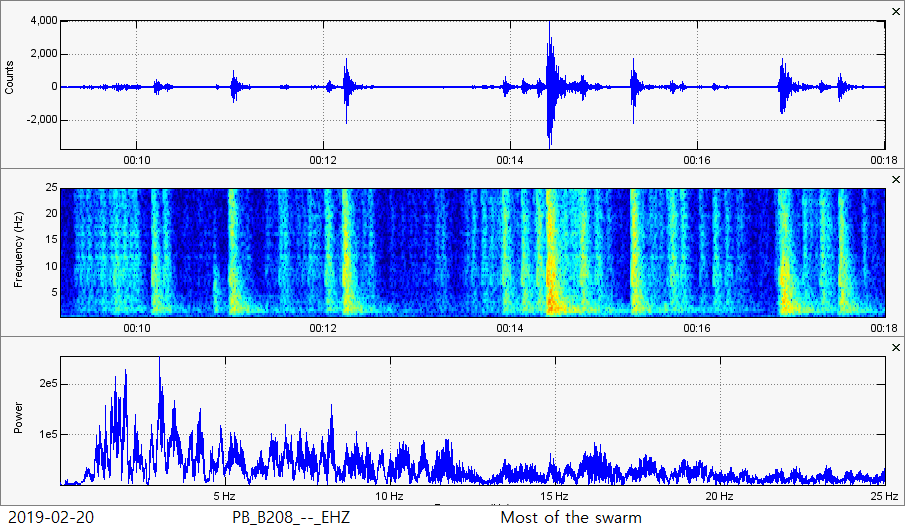
Total earthquake count (includes even the tiniest events): Approximately 40-45 micro-quakes in only 16 minutes. Remember, the amplitudes were very small!
Reported count: N/A
Magnitudes/Depths of reported events for this swarm from newest to oldest: N/A
Largest reported earthquake of this swarm: N/A

Largest amplitude: 4,060 (B208), 1,850 (YLA)
USGS EQ map for this swarm: None have been reported… Yet!
Severity: Minor
Picture
A seismogram, spectrogram, and spectra plot of most of the rapid-fire swarm.
Picture
This event, which is also shown in the slideshow below, details the first event of the swarm. It contained very weak amplitudes, going no more than 400 amplitude count, but almost looks like one long period event! However it is likely this "one event" is composed of 7-8 micro-quakes occurring in such rapid succession it looks like one event. Crazy stuff! However it would be much crazier if the amplitudes were much larger.
Ten 3-plot images in slideshow format detailing most of this swarm:
Remember how, in the video shown first in this post, that activity was extremely calm prior to the swarm? And how once the swarm occurred, many low amplitude low frequency earthquakes started to pop off like crazy? They were small, yes, but important nonetheless. The fact that they are calming down now and were not present to the swarm, suggests to me the swarm itself caused these low frequency events. I don't know what process caused the swarm and low frequency events, but no doubt they are connected! Below I detail six 3-plot images showing some of the low frequency events that transpired after the swarm:
0 Comments


Leave a Reply.

    About

    Please click a post title to view the data pertaining to that event!

    This is the seismic events page for Yellowstone National Park and Caldera, which resides in northwest Wyoming. Yellowstone is an absolutely massive caldera super-volcano. It sits at a shocking perimeter of 34 by 45 miles (55 by 72km) and that is only the caldera boundary! A caldera is created when land immediately erupts and collapses, while the magma chamber almost completely empties, creating a crater imprint called a caldera. Some calderas around the world are small in comparison (i.e. Kilauea) to other calderas formed by super-volcanic eruptions (i.e. Yellowstone in Wyoming or Long Valley in California).  Yellowstone is theorized to contain a magma chamber and a much deeper, much larger magma reservoir just beneath the chamber. This two-chamber system is also theorized to be caused by a "magma plume". Magma plumes are thought to draw their eruptive ability from deep within our planet, possibly from our lower mantle. That is why volcanoes caused by magma plumes are much more dangerous and far more unpredictable than their counterparts that are caused by normal tectonic forces. Yes, many volcanoes are caused by tectonic forces as one plate attempts to breach or dip beneath another one. A perfect example of this is the Cascade Range on the West Coast of the United States. Many volcanoes in the world are caused by this but some, the more unpredicatble ones, are caused by magma plumes.

    Remember to always pay attention to all chart labels! All images were generated by myself using the IRIS DMC seismic archive and the FREE seismic program S.W.A.R.M.

    Archives

    February 2020
    December 2019
    August 2019
    July 2019
    June 2019
    May 2019
    March 2019
    February 2019
    January 2019

    Categories

    All

    RSS Feed

Home

Hawaii Blog

Yellowstone Blog

Steamboat Geyser 2019

DISCLAIMER: There are currently problems with some images not showing or images being the incorrect ones. If you see this problem, please notify me. I am attempting to resolve this issue.
Copyright © 2019
  • Home
  • Yellowstone
    • Yellowstone Blog
    • 2008-2009 Yellowstone Lake Dike Intrusion
    • Rapid-Fire Swarms 2014-2018
    • Steamboat Geyser Eruptions >
      • Steamboat Eruptions 2020
      • Steamboat Eruptions 2019
      • Steamboat Eruptions 2018
  • Hawaii
    • Hawaii Blog
    • Hawaii Spasmodic Tremor
    • 2018 Kilauea-LERZ Eruptions
  • How To...
    • ...Retrieve Seismic Data
    • ...read webicorders/helicorders and seismic plots
    • ...Understand Spectrograms
    • ...USE SWARM Software
    • ...use jamaseis program
    • ...use waves program
    • ...understand UTC
    • ...Read/Create GPS Deformation Charts
    • ...use s.w.a.r.m. program (OLD)
  • Seismic Events
    • Event Examples
    • Exotic Events
    • Whale Calls
    • Cascade Volcanoes' Low Frequency Events
  • Seismo-Blog
  • Other Seismic Blogs
    • Quake Swarms
    • United States
    • East Coast, USA
    • World
  • Monthly Volcano Updates
  • Uplift/Subsidence Update
  • Videos/Multimedia
    • Newberry Videos
    • (OLD) 2019 Monthly/Yearly Updates
  • Seismic Software
    • jAmaSeis
    • SWARM
    • WAVES
  • Seismic Network Help
  • Links
  • About Me
  • Contact
  • Test Your Knowledge!
  • Lucas Andrew Ferraiuolo (Pro Pics)
  • Garbage Trucks?!